Site-specific apartment show “Station” in Düsseldorf, Germany, Derendorf area. 2025- 07- 17-19 17-20Uhr
Photos by JMR Dokumentation
Down bellow text by Dennis Graemer
Station by Julija Skudutytė
The artist posts a video. In it, she appears as an angelic figure surrounded by light, telling you that “it’s not too late”, that “you are loved” and that you should “come to the Station”. I bit much, but you are intrigued. So you decide to follow the call, and make an appointment.
This is a home exhibition – the only kind of exhibition that is not immediately recuperated by the institutions. Not a museum, not gallery, not even that artist-run underground gallery Germans call “offspace”. Just a flat, somewhere in Düsseldorf.
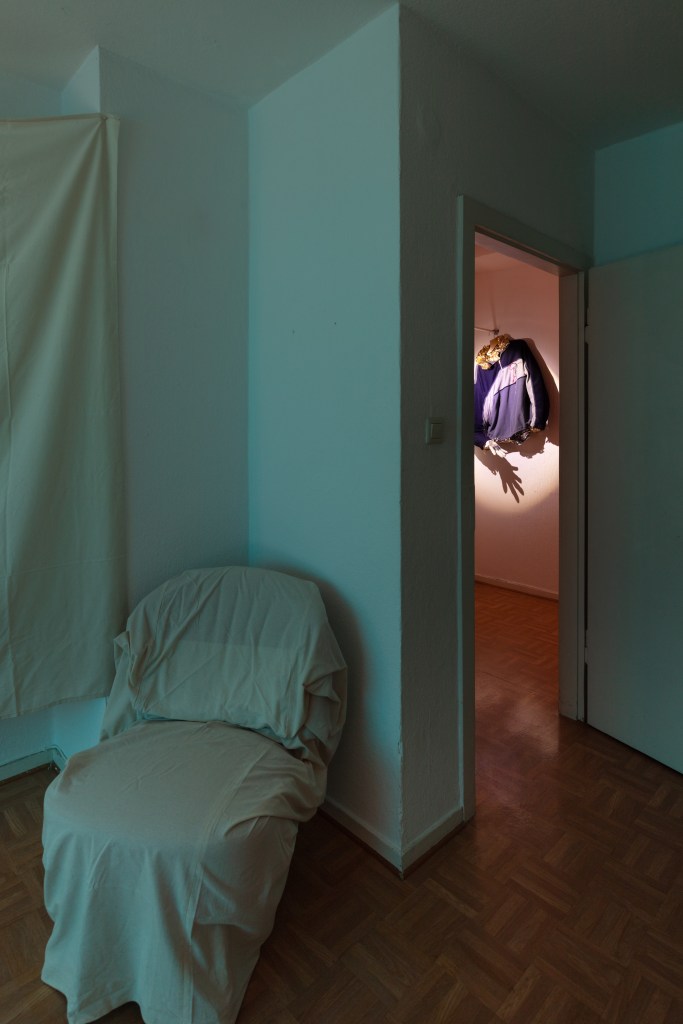
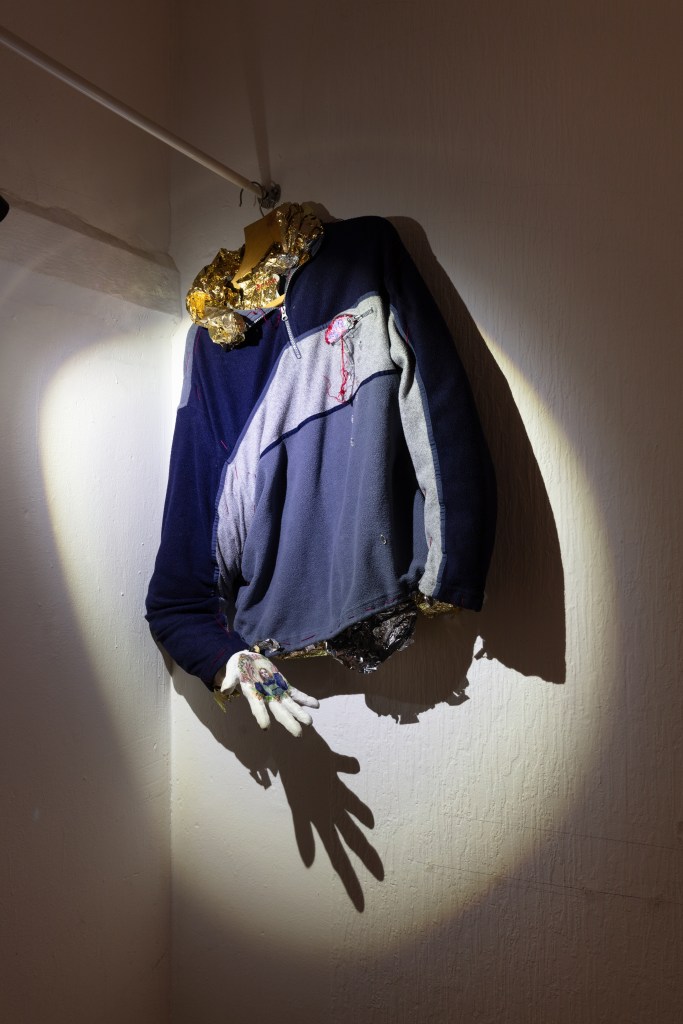
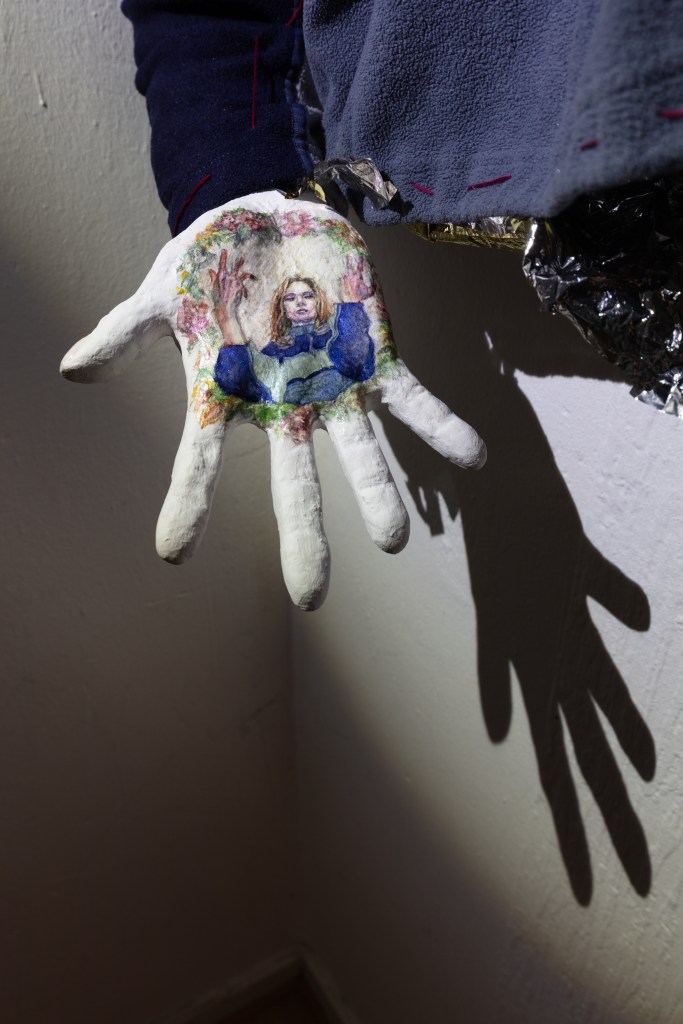
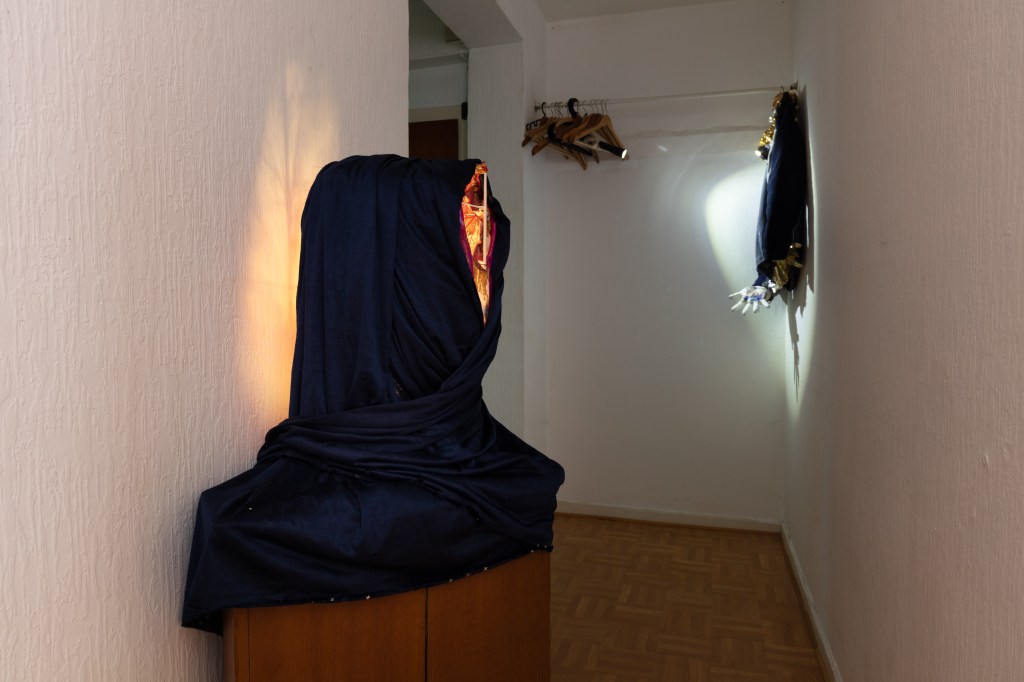
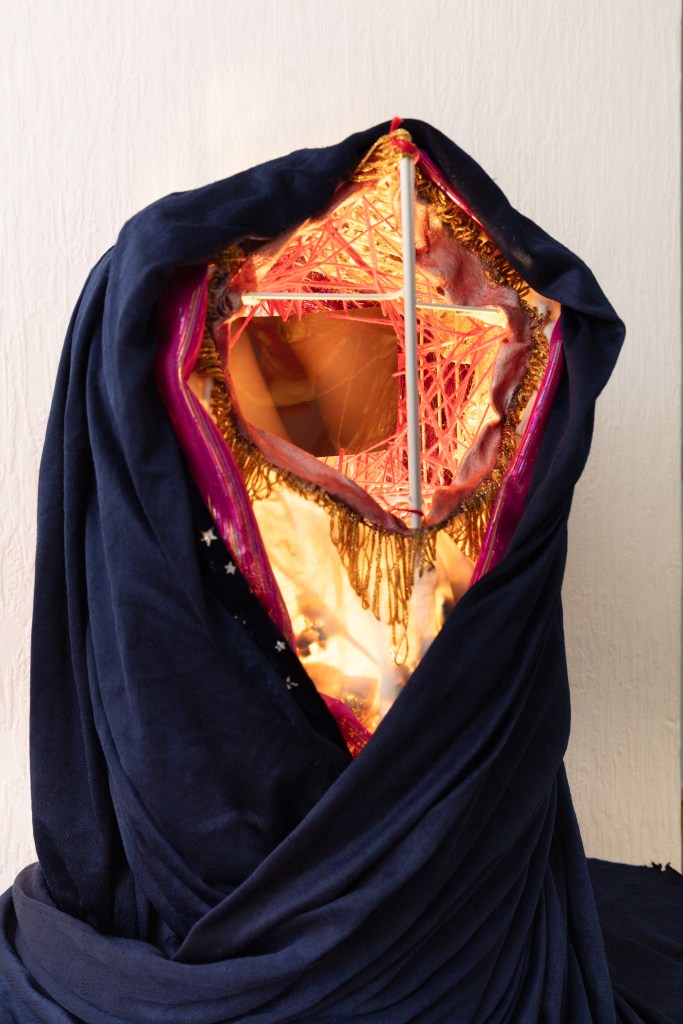
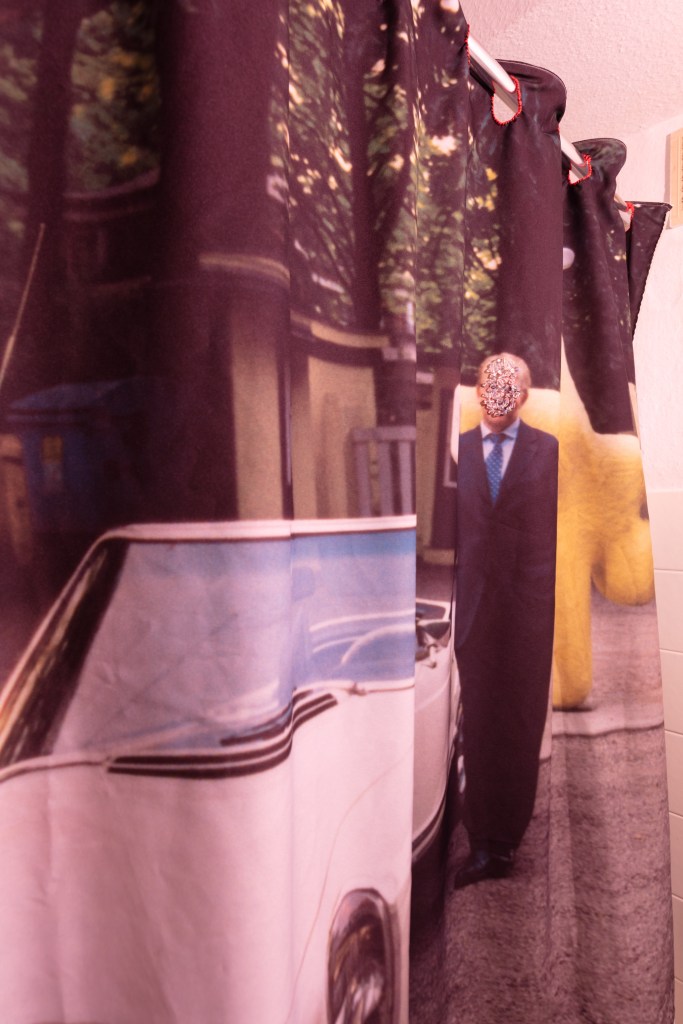
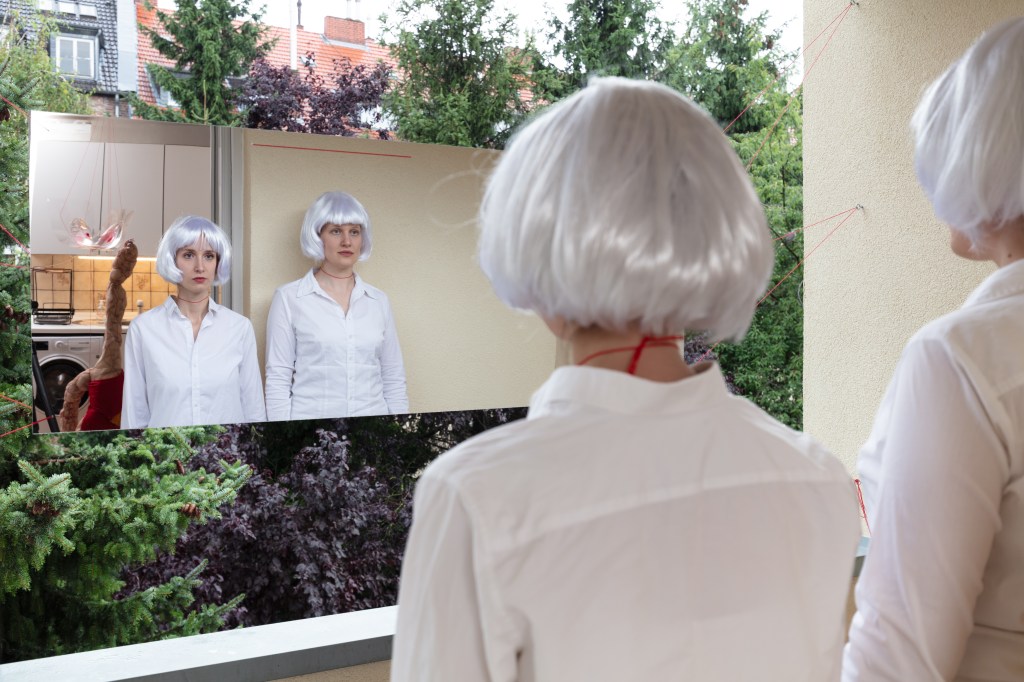
So when the day comes, you ring the bell. Once inside the apartment, you are greeted by two young women. Both clad in white, both wearing silvery whigs. A kind of uniform. With one voice, they welcome you, offering the choice between water and prosecco. The hallway exhibits two sculptures: To your right, you see a sweater adorned with something that looks like golden aluminium foil. From the right arm, a hand protrudes. On it, a small painting in the artist’s likeness, portraying her as the Virgin Mary. The other sculpture looks like a hooded head. There is light inside, and where the face should be you see a dark picture held by red threads.
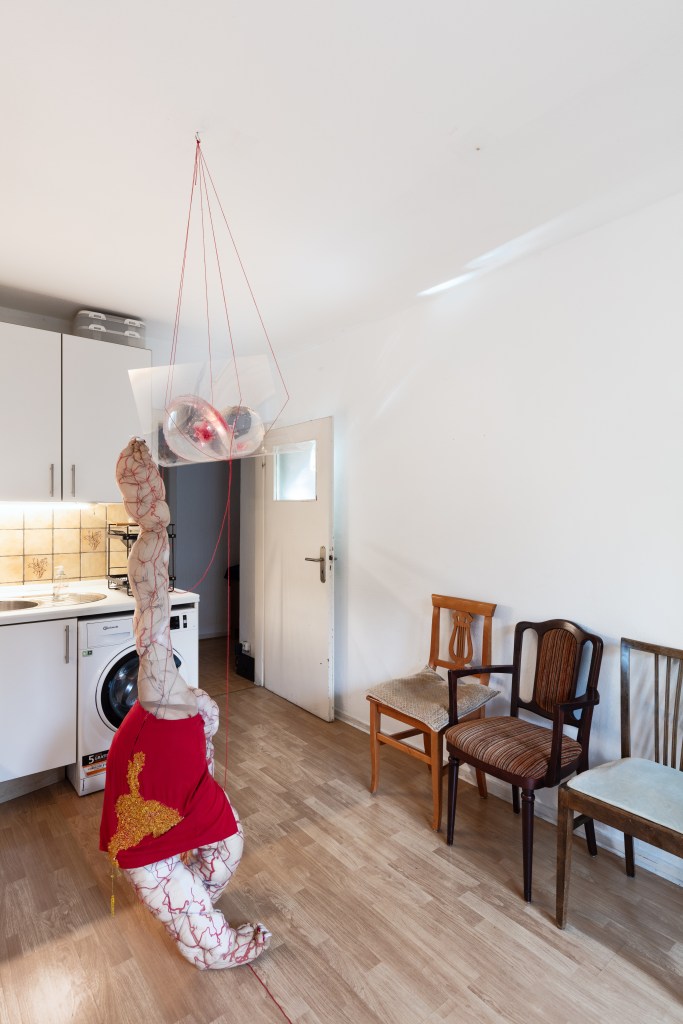
Entering the kitchen, your attention is immediately captured by a large puppet occupying the center of the room. Built from some pillow-like material and dressed in pants and other clothes, the headless, humanlike sculpture grasps for the sky. It looks kind of funny, and unsettling at the same time. Above it, placed on a translucent plane, lie two female breasts. A desperate scene inviting a psychoanalytic reading.
You notice one of the women watching you in silence. The other host faces a blank wall. Your attention shifts to the room itself. Opposite to the fridge, a few chairs are arranged in a row. You are reminded of the waiting rooms in a train station. Suspense in the air. A sudden awareness of a clock ticking loudly. You and the other guests are waiting. Waiting for what?
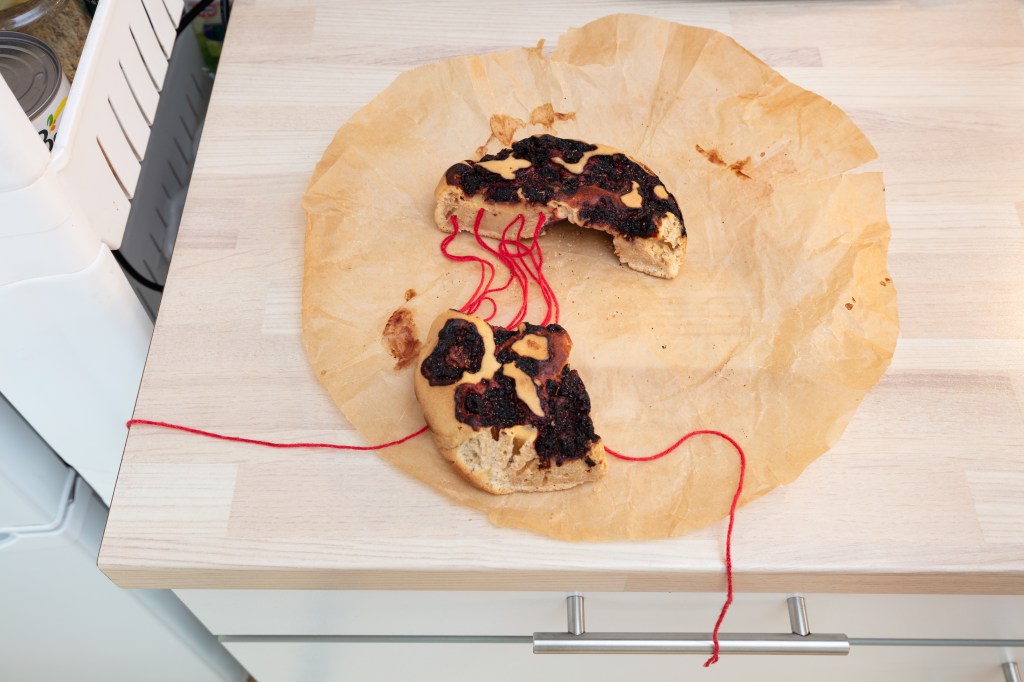
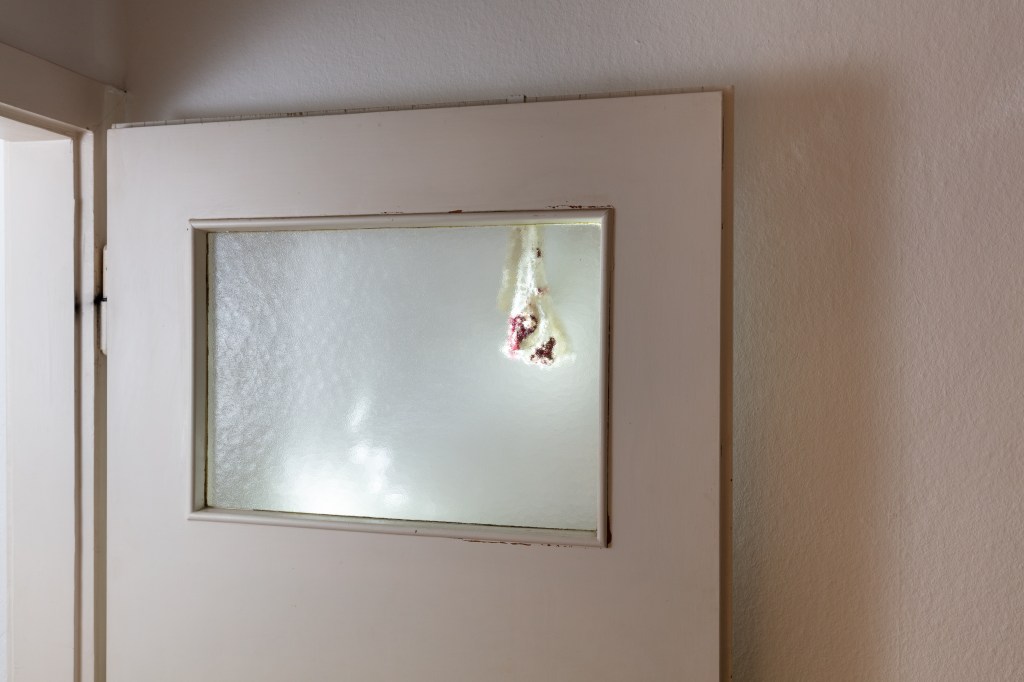
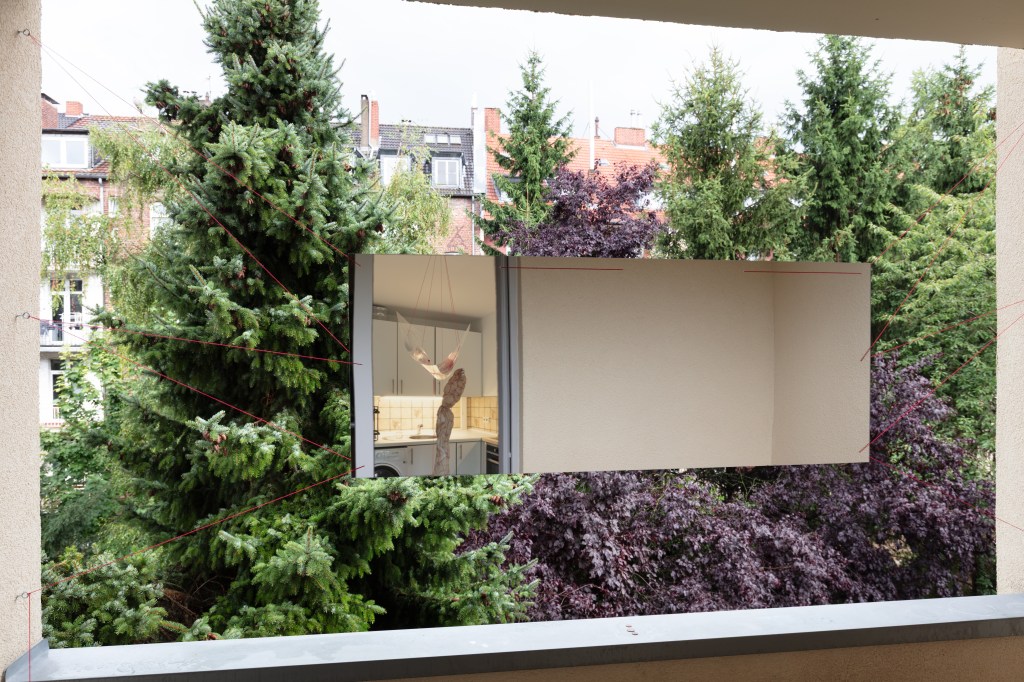
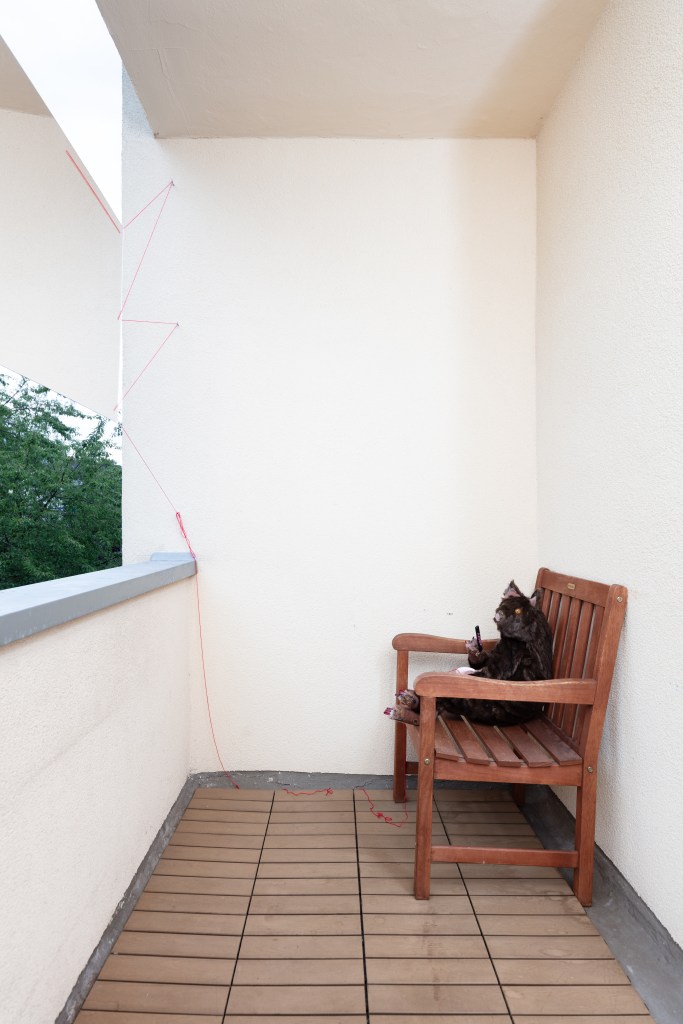
Everything is connected by red threads. They lead to the balcony, holding a large mirror up in the air. They lead to a sculpture of a black cat vaping arrogantly. For once, the symbolism is overt. Following the thread as in understanding whats up. A reference to “roter Faden”, a German expression denoting unity of different elements under a singular theme. But can you actually do it? Threads everywhere, and no easy answers.
A gong chimes. In a sudden, orchestrated movement, the hosts leave the kitchen, retreating into a private room. A few seconds pass. They reappear, again offering everyone water and prosecco. A planned performance, demonstrating that this is not a static exhibition, that things might happen.
When a guest asks the women a question, they reply with a riddle, or ask back. Sometimes they stare into a wall. Their performance is just that, a performance. Yet still, it is impossible to not take it as dead serious. Palpable tension. The feeling that this is not an art exhibition, but a cult. A cult built on longing, something which presents itself as the answer.
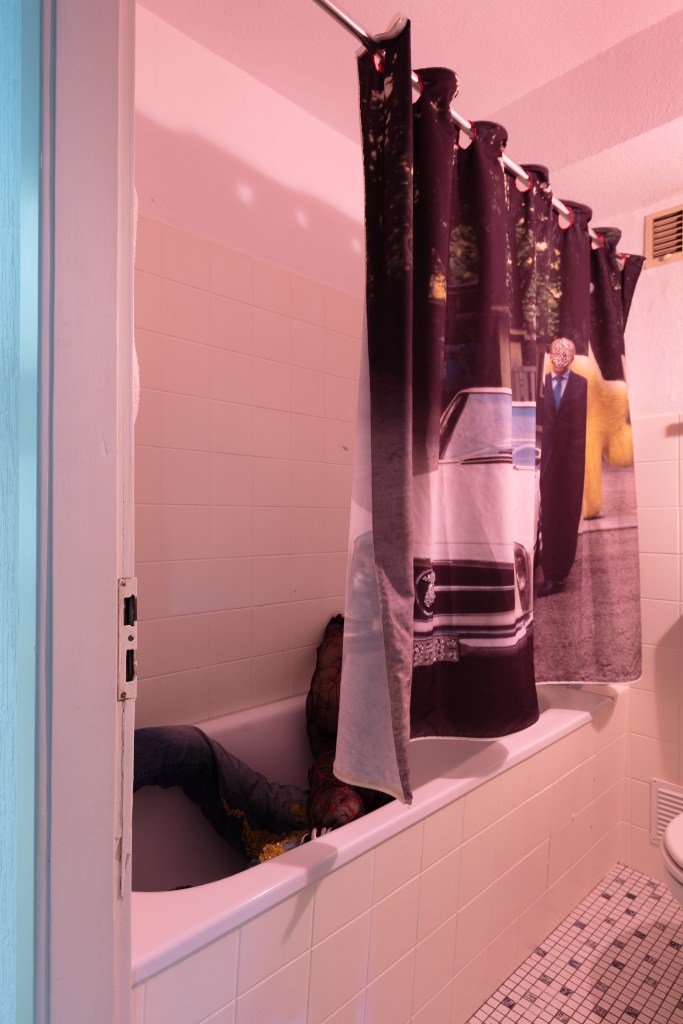
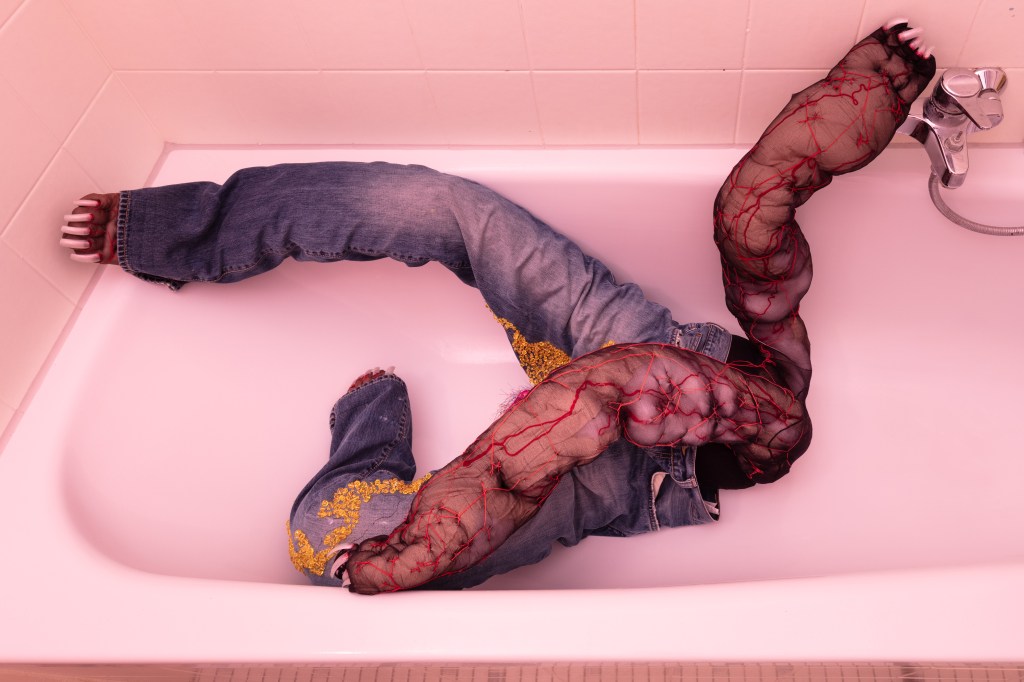
At some point, you will probably visit the bathroom. It smells of bleach. There is a single soap dispenser labeled “Station”. In the bathtub lies a figure similar to the one in the kitchen, this time with exposed scrotum, this time longing for the faucet, for water, for life.
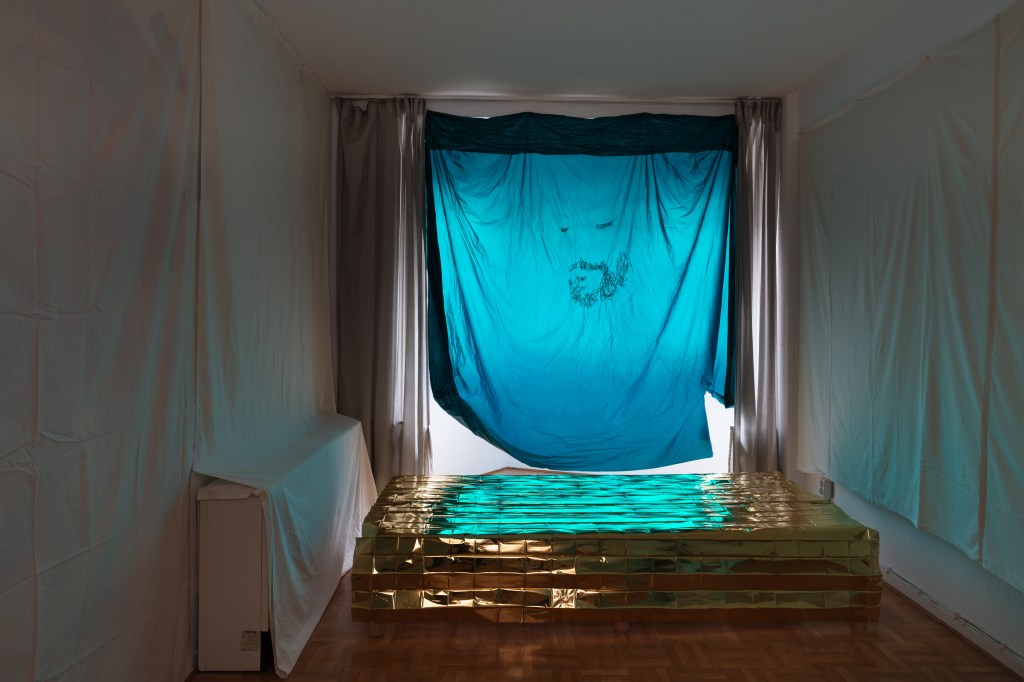
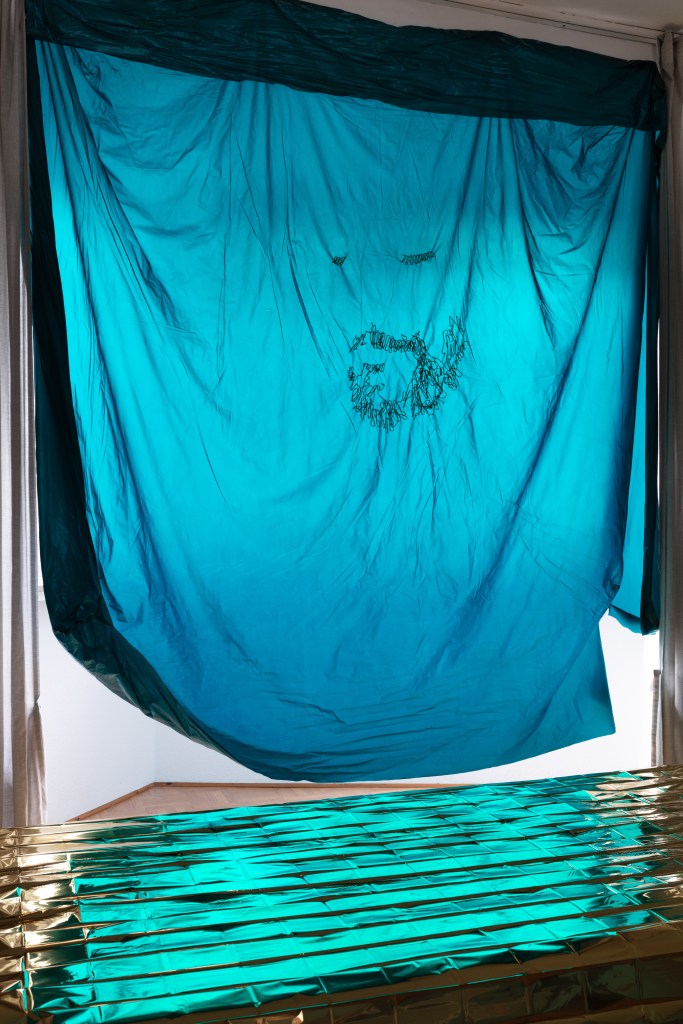
The last room. A green tint. In the middle, a rectangular object made out of golden tinfoil. An altar. No threads this time. On the far end of the room, a piece of fabric depicting the contours of a bearded face. Someone uses the term “skydaddy”. This room is very different, it radiates serenity, peace. It is much less threatening – and less interesting? – than the rest of the exhibition. It’s power is not the power of suspense, but the power of grounded silence.
Of course, every sculpture can be imagined as an individual piece of art. Station, however, is not a white cube. It must be viewed not as an exhibition, but as Gesamtkunstwerk, as a collage of material objects, rooms, sounds, actions and moods. It must be viewed holistically. It must be viewed as installation art.
Installation art creates immersive environments in an attempt to curate experiences, turning the exhibition into a kind of theatre. While a classical museum separates the space from the art, isolating single works for contemplative purposes, the installation invites the visitor to embed themselves into a comprehensive experiential totality.
Skudutytė however provides more than just a total installation. Her inclusion of performantive elements creates an installation that is, in contrast to Kabakov’s works, truly alive. Classical installation art presents us with a dead space, a passive cosmos in which the artist has inscribed their vision. The classical installation is a static edifice devoid of the possibility of change. Any interaction between visitor and work remains embedded within the visitors head.
By including the mysterious women in white, Skudutytė implements a back and forth which shapes the visitor’s perception. What are they going to do next? Can we approach them? Only the right questions will be answered by new riddles. Those who decide to do something impart themselves onto this dynamic environment. Action becomes interaction.
Skudutytė uses this formal aspect in order to explore the interconnection of lack, faith, and secrecy as contemporary social phenomena. By contrasting suffering figures and smug cats with the patriarchal presence of “skydaddy”, Skudutytė alludes to the dialectical relationship that connects the playful insecurity of the digital age with a renewed interest in traditionalism and religious devotion. We are transcendentally homeless – everything is just a Station – and transcendentally headless – like Skudutytė’s longing sculptures. This is a form of freedom. But it also leads us to seek comfort, especially in an age of war and instability.
Station feels like a cult house. Cults form the synthesis of “skydaddy” style religion and headless alienation. They are that which lurks beneath, the possibility of a transcendental home and of secrets. Join one, for “it’s not too late”. You will feel that “you are loved”. As atomized subjects caught in the speed vector of technosocial acceleration and accustomed to the stimulations of the digital, this is just what we want.
Everything else remains the secret of those who were ready to heed the call to “come to the Station”.
Text by Dennis Graemer
 Julija Skudutytė